
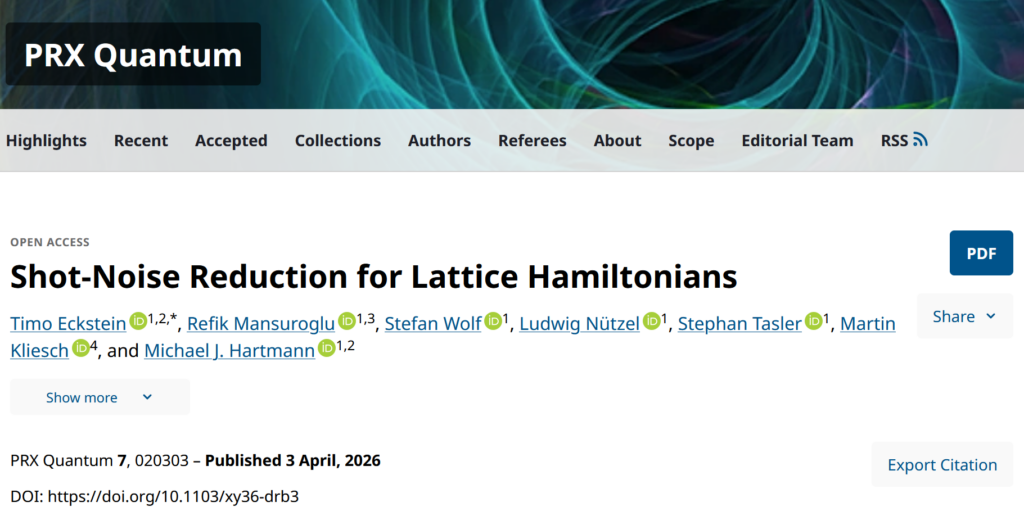
Our work 𝐒𝐡𝐨𝐭-𝐧𝐨𝐢𝐬𝐞 𝐫𝐞𝐝𝐮𝐜𝐭𝐢𝐨𝐧 𝐟𝐨𝐫 𝐥𝐚𝐭𝐭𝐢𝐜𝐞 𝐇𝐚𝐦𝐢𝐥𝐭𝐨𝐧𝐢𝐚𝐧𝐬 has just been published in 𝐏𝐑𝐗𝐐𝐮𝐚𝐧𝐭𝐮𝐦. Directly go to the paper here: https://doi.org/10.1103/xy36-drb3
By: Timo Eckstein, Refik Mansuroglu, Stefan Wolf, Ludwig Nützel, Stephan Tasler, Martin Kliesch, and Hartmann Michael
In quantum computing, in contrast to its classical counterpart, the result of our computation is typically not a single deterministic bitstring but a probability distribution encoded into a quantum state. Hence, a central task after state preparation is to efficiently extract information from this probability distribution, which, on a real-world quantum device, corresponds to measuring the generated quantum state. Particularly relevant near-term measurement tasks are those for energy estimation of low-energy stats, as they are considered an enabler for material science research via quantum computing.
Here, we present a measurement scheme for estimating the energy of quantum lattice models from measurements of a prepared quantum state. We prove that it always requires fewer measurements for the same precision as “naive” sampling in mutually commuting groups. Our method is based on partitioning the lattice into local patches and then measuring those in the eigenbases of their local Hamiltonians via a transformation of local eigenstates into the measurement basis, typically reducing the required number of measurements by several orders of magnitude.
We expect our results to have a noticeable impact on near-term eigenstate preparation algorithms, as those typically need to estimate the state’s energy numerous times. Importantly, the patch size can be freely chosen to fit the available gate budget, starting from as little as 𝑛/2 additional 2-qubit gates, which are simply appended to the end of the existing quantum circuit.
We acknowledge support from FAU Erlangen-Nürnberg, FAU Profile Center Light.Matter.QuantumTechnologies, Max Planck Institute for the Science of Light, University of Vienna, Hamburg University of Technology, Erlangen National High Performance Computing Center (NHR@FAU), Deutsche Forschungsgemeinschaft (DFG) – German Research Foundation (QuCoLiMa), Bundesministerium für Bildung und Forschung (EQUAHUMO), IMPRS Physics of Light, Fujitsu Germany GmbH and Bavarian State Ministry of Science and the Arts and Bayerisches Staatsministerium für Wirtschaft, Landesentwicklung und Energie via Munich Quantum Valley, Elite Network of Bavaria, Hightech Agenda Bavaria